The AIMP’s purpose is to digitize, compile, and when possible, freely disseminate archival records from any and all sources pertaining to the Iron-Clad Monitors of the American Civil War, especially the Passaic-Class of Captain John Ericsson’s Monitor warships. The intent is to confirm/ verify the accurate internal arrangements of spaces and the specific mechanical features of each of the ten Iron-Clads of the Passaic-Class. With the confirmation of the internal arrangements create and release historically accurate and highly detailed digital renderings of the vessels and specific situations surrounding their service to our Nation during the brutal War of the Rebellion. If public interest favors, and the various hurdles deemed surmountable, the eventual construction of full-scale replicas of the USS Camanche near San Francisco or Mare Island, California and the USS Patapsco near Charleston or Port Royal/ Hilton Head, South Carolina.
In 2019 I (T. Adam Bartel) began an ancestry project with a profound lack of knowledge pertaining to my background and the people that came before me. In this personal journey I discovered that my 3rd-Great-Grandfather (3G-Grandfather) Lewis William Thomas was a sailor on-board the United States Iron-Clad Steamship: Sangamon (USICS Sangamon), the sixth of ten of Captain John Ericsson’s Passaic-Class Iron-Clad Monitors. This revelation was compounded by the fact that Lewis had already lived an astonishing life and would continue to long after the American Civil War; Lewis would become the first African American Policeman in Saint Paul, Minnesota in 1881. Compiling this research has been among the most fulfilling tasks I have attempted in my life – including nearly eight years in the U.S. Army and graduating from two acclaimed trade schools.
The Passaic-Class monitors represent a mostly forgotten leap forward in naval technologies from the namesake USS Monitor into the modern warships we all know and understand today. In what I naively assumed to be a simple Google search to answer my increasingly stubborn need to understand these vessels I learned that not only do these astonishing warships have a lingering air of mystery, but that the ability to clear that historical fog is hindered by nearing two centuries of summaries with varying degrees of accuracy or clarity. The fine mechanical details of these Iron-Clad warships were too many researchers completely lost and even worse not worth finding.
After finally learning of Lewis’ exploits, I began an exhaustive two-year research journey compiling nearly every shred of American Civil War (ACW) era newspaper articles, sailor descriptions, correspondence, dozens of photographs, dozens more illustrations and yet I could still not definitively describe what the interior of these vessels looked like. That is where the imperative founding and purpose of the AIMP became clear; I needed to source this information from the National Archives and any and all institutions that hold artifacts or documentation and digitize these historical records for posterity. In the pursuit of this goal, I have amassed over 60 (sixty) painstakingly scanned plans and blueprints from the National Archives (NARA) location in College Park, Maryland in partnership with another research agency, Footsteps Researchers LLC., and two separate highly respected experts (Professor Greg Johnson & Mr. James D. Spirek), both of whom are Advisors/ Consultants on this project.
The invaluable experience I earned at The Colorado School of Trades (CST) in Lakewood, Colorado and the former NTMA Machinist Career College (National Tooling and Machining Association) campus in Santa Fe Springs, California trained me to understand the fine arts of interpreting intricate blueprints but also the manufacturing processes required to turn an engineer’s vision into tangible products.
Also imperative in understanding not just the nuts and bolts of these warships is to understand them as my 3G-Grandfather Lewis would have. To do this the AIMP aims to not only freely publish the results of our archival work at College Park, Maryland, but to also digitize all of the daily Deck Logs that each Navy warship maintained documenting events big and small. These incredible resources held at NARA in Washington, D.C. give insight into life aboard that is not in any book, or publication. I have procured one full set of deck logs that encompass three volumes (one per year of commissioned activity, 1863-1865) for the USICS Sangamon. I would need to digitize the remaining surviving records to complete the documentation of the class’s actions throughout the ACW in detail before impossible.
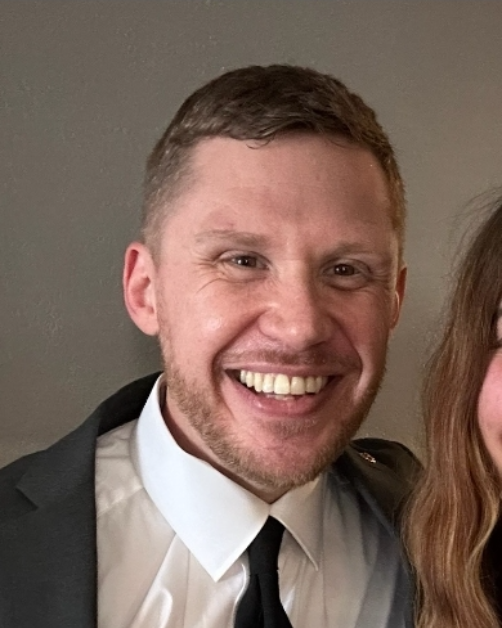
A Little About Me: T. Adam Bartel
Born to Tom Bartel & Lynda Thomas on 16 September 1989 in Susanville, California and graduated from Lassen Union High School, alumni class of 2007. Married Jaron Michael Robbins on a remote island in the San Juan Archipelago on the U.S. & Canadian border in 2018. Proud uncle of six nephews with a twenty-one-year span from eldest to youngest!
I enlisted in the U.S. Army on 28 February 2008 as a 12B Combat Engineer and attended OSUT (One Station Unit Training which combined Basic Combat Training (BCT) and Advanced Individual Training (AIT)) on Fort Leonard Wood, MO. with A CO (Alpha Company), 35th EN BN (Engineer Battalion), 1st ESB (Engineer Special Brigade), USAES (United States Army Engineer School). I was quickly deployed out of Fort Riley, KS. after my 18th birthday and performed QRF Security for an element of the 731st EOD BN (Explosive Ordnance Disposal Battalion) and then near daily route & area clearance operations on my deployment to Baghdad, Iraq from October 2008 to October 2009 with 1st PLT (Platoon), C CO, 2nd HBCT STB (Special Troops Battalion of the Heavy Brigade Combat Team), 1st ID (Infantry Division). I performed similar clearance operations as an Engineer Explosive Ordnance Clearance Agent (EEOCA) around Kandahar, Afghanistan in 2011-2012 with 4th PLT, C CO, 2 HBCT STB, 4th ID, while in Afghanistan I earned my final rank as a Sergeant (SGT). I then served as a Junior Operations NCO and Small Unit/ Individual Counter-Improvised Explosive Device (C-IED) Tactics Instructor for the Engineer Basic Officer Leadership Course (EBOLC) on Fort Leonard Wood, MO. until 2015 with FOX Team, B CO, 554th EN BN, 1st ESB, USAES. Essayons!
Previous teenage volunteer with the Lassen County EMS Explorer Post from 2003-2006 which eventually led to a NREMT-B Certification from Pikes Peak Community College in Colorado Springs, CO. in 2010. After separating from the Army, I attended higher level education classes as time allowed at Shoreline Community College north of Seattle, WA., and Red Rocks Community College west of Denver, CO. In February of 2022 I graduated from and attained an associate's degree in fine arts from The Colorado School of Trades near Denver, CO. and in 2023 attained a Certificate of Machining Skills from the National Tooling & Machining Association (NTMA) campus formerly in Santa Fe Springs, CA.
In April 2026 formed “Grim Sentinels Research” as a Sole Proprietorship and FBN/ DBA. Co-founded “The American Iron-Clad Monitor Project Inc.” 501c3 in July 2026.
Member of the Association of the United States Army (AUSA), Army Engineer Association (AEA), Society of the 1st Infantry Division (BRO), Association of the 4th Infantry Division, and Post 43 of the American Legion in Hollywood, CA.
Contact us!
Interested in working together or just curious? We need help from nearly every profession and trade. Please fill out some info and we will be in touch shortly. We can’t wait to hear from you!